Wednesday, January 25, 2017

New Frontier Foods Expands Ocean's Halo® Product Line Launching Delightfully Sweet Dark Chocolate Seaweed Strips


- The Seaweed Strip™ with Dark Chocolate Continues Industry-Leading Product Innovation

- Company also adding USDA Organic Sushi Nori to Product Line

- Chili Lime and Korean BBQ Expand Flavors of The Seaweed Snack™ Sheets

- Cerritos, CA Plant Now SQF Certified
 New Frontier Foods, maker of Ocean's Halo® seaweed products, today announced a
 significant expansion to its product lines and manufacturing capabilities debuting at 2017
 Winter Fancy Foods show on January 22nd through the 24th in booth #3000, at the
Moscone Center in San Francisco, California. The new product offerings include:

  • A first-of-its-kind Dark Chocolate Seaweed Strip: Imagine two thin layers of 
  •  seaweed surrounding a crunchy layer of Almonds or Coconut, with just the right
  •  amount of delicious dark chocolate in the middle. Both the Almond and Coconut 
  • skus are our highest-ever scoring products in pre-launch taste tests, and are an
  •  expansion to The Seaweed Strip™ product line.
  • Chile Lime and Korean BBQ Flavors Added to The Seaweed Snack™ Sheets: 
  •  Our popular USDA Organic sheeted seaweed snacks now have two new flavors – 
  • Chili Lime and Korean BBQ – which also remain available in Sea Salt, Maui Onion,
  • Texas BBQ and Sriracha flavors.
  • Organic Ocean's Halo ® Sushi Nori – to satisfy growing market demand for at
  • -home sushi products, a high-quality line of organic sushi nori will debut in the Spring 2017
  • US Production Facility Now SQF Certified – Our seaweed production facility in 
  • Cerritos, California was SQF certified in the fall of 2016. 
Commenting on the expansion, Ocean's Halo® co-founder Robert Mock noted:
"Seaweed shouldn't be boring. Consumers deserve new and interesting products
and we're going to be relentless in our pursuit of product innovation. We couldn't be
 more excited about the dark chocolate strips, new flavored sheets and the organic
 nori. And stay tuned for another completely new product later this year."
Shoppers can now find Ocean's Halo® Seaweed snack products in Whole Foods,
Costco, Albertsons, Safeway & Vons, Ahold, Mollie Stones and a growing number
of natural, grocery and specialty markets, co-ops and restaurants in the US and
abroad. Ocean's Halo® is also sold on Amazon.com.
Retailers interested in ordering please email sales@oceanshalo.com. For more
 information about Ocean's Halo® and to find a retailer near you, go to www.oceanshalo.com
or join the Ocean's Halo® conversation on Facebook at www.facebook.com/OceansHalo,
Twitter and Pinterest @OceansHalo #SwimAgainstTheTide.
About New Frontier Foods Inc.  Based in the San Francisco Bay Area, New Frontier Foods Inc. was founded in 2011
by four dads on a mission to leverage the science of superfoods to make ordinary foods
delicious and healthy. Ocean's Halo offers totally delicious crispy, crunchy snacks made
rom USDA Organic, sustainably harvested seaweed.  We are proud to donate two
 percent of our profits to organizations like the Monterey Bay Aquarium's Children's
 Education Fund program that is inspiring the next generation of ocean evangelists.


CONTACT: Press@OceansHalo.com


Monday, January 23, 2017

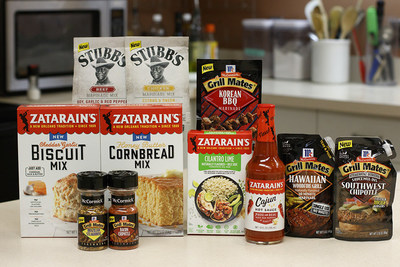
McCormick Announces Spring New Product Lineup


Cajun Hot Sauce, Korean BBQ Marinade, new offerings bring serious flavor to the grill and kitchen
McCormick & Company, (NYSE: MKC) a global leader in flavor, is launching a range of
 new products bringing flavors from around the world, and across America to kitchens
 and grills this spring. The 17 new products answer consumer demand to explore
 regions through taste, while still offering ease and simplicity in the form of quick marinades,
 baking mixes and sauces.
"Beyond spicy or tangy, consumers want to experience the authentic flavors of places
like Hawaii, New Orleans and Brazil," said Virginia Jordan, McCormick Vice President
of Marketing. "Our new products make it easy to enjoy these tastes at home, whether
adding a splash of Cajun Hot Sauce to fried chicken or marinating steak in our Korean
BBQ marinade."
McCormick Grill Mates: With Hawaiian cuisine taking over the mainland, and
churrascarias and Korean BBQ in towns across the country, these new Grill Mates
 liquid marinades, mixes and seasonings allow grillers to add flavors they enjoy at
restaurants to cook-out staples this spring and summer.
Stubb's: New seasoning mixes were specially created to flavor different types
of meat – from pork to steak and chicken – with big Texas taste.
Zatarain's: Hot sauce and biscuits are staples of the Southern food scene.
Zatarain's first-ever hot sauce is made with aged red peppers, Cajun spices
and big chunks of flavorful garlic. And, new mixes for flaky biscuits and
 crumbly cornbread are made with no artificial flavors, colors or preservatives.
For more new product information and high-res images, visit McCormick.com/SpringLineup.
About McCormick
McCormick & Company, Incorporated is a global leader in flavor.
With $4.3 billion in annual sales, the company manufactures, markets
and distributes spices, seasoning mixes, condiments and other flavorful
products to the entire food industry – retail outlets, food manufacturers and
foodservice businesses. Every day, no matter where or what you eat,
you can enjoy food flavored by McCormick. McCormick Brings Passion to Flavor™.
For more information, visit www.mccormickcorporation.com.
CONTACTS:
Laurie Harrsen
McCormick & Company, Inc.
410.527.8753
Laurie_Harrsen@mccormick.com
Lauren O'Leary
APCO Worldwide
646.556.9323
Loleary@apcoworldwide.com

Friday, January 20, 2017

Cheesy pull-apart bread


Made with hand-stretched cheese that’s made to be melted, this party-sized appetizer makes an impressive entrance and tastes even better than it looks.


Ingredients

1 (700 g) round loaf of bread
3/4 cup (175 mL) salsa verde, homemade or store-bought
10 oz (300 g) Canadian Mozzarella, sliced

Salsa verde:
1 clove garlic
1/2 onion, coarsely chopped
1 jalapeno pepper, seeded
1/2 cup (125 mL) cilantro
1 can (820 mL) whole tomatillos, drained
Lime juice
Salt


https://www.dairygoodness.ca/recipes/cheesy-pull-apart-bread

Thursday, January 19, 2017

Creating A Profession And Improving Health: Academy of Nutrition and Dietetics Celebrates Its Centennial In 2017


CHICAGO, Jan., 2017 /PRNewswire-USNewswire/ -- The Academy of Nutrition and Dietetics, the world's largest organization of food and nutrition professionals, will celebrate its 100th anniversary in 2017 by honoring the dietetics profession and forging a new vision for the Academy's Second Century.
For the past 100 years, the Academy (www.eatright.org) has been dedicated to building a profession that optimizes health through food and nutrition. The Academy was founded as the American Dietetic Association in 1917 by a visionary group of women committed to taking on the greatest food and nutrition challenge of the day: conserving food, feeding the troops and nourishing Americans while combating malnutrition in the face of severe food shortages during World War I.
"Our founders created an organization and a profession that changed the course of food, nutrition and health," said registered dietitian nutritionist and the Academy's 2016-2017 President Lucille Beseler.
Today, the Academy represents more than 100,000 registered dietitian nutritionists and dietetic technicians, registered, working across the food and health spectrum in hospitals, foodservice, academia, business, wellness, agriculture, public health and private practice. The Academy continues to provide unequalled, evidence-based nutrition practice resources for its members and health professionals.
"The Academy of Nutrition and Dietetics has built on the legacy of our brave and inspirational founders as we address food and health systems that have changed significantly, becoming more global and complex," Beseler said.
"The ability to feed people and feed them well is a challenge we face in our homes, our schools, our communities, our nation and around the world. Yet these challenges also present unique opportunities for innovation and collaboration between nutrition professionals and other leaders," Beseler said.
A significant part of the Academy's Second Century includes expanded international collaborative relationships. In September 2016, the Academy convened the Nutrition Impact Summit, which brought together nearly 200 Academy members and thought leaders in food, wellness and health care systems to identify potential projects and strategic partners in the U.S. and worldwide. 
"Honoring our legacy means unflinchingly addressing the health challenges of the present day, our present century and the next. The Academy's vision for the Second Century is grounded in an extraordinary commitment to collaboration, a focus on service and an emphasis on creating a world where people and communities flourish because of the transformational power of food and nutrition," Beseler said.
The Academy will commemorate its centennial throughout 2017, at the Academy's Food & Nutrition Conference & Expo™, to be held October 21 to 24 in Chicago.
All registered dietitians are nutritionists – but not all nutritionists are registered dietitians. The Academy's Board of Directors and Commission on Dietetic Registration have determined that those who hold the credential registered dietitian (RD) may optionally use "registered dietitian nutritionist" (RDN) instead. The two credentials have identical meanings.
The Academy of Nutrition and Dietetics is the world's largest organization of food and nutrition professionals. The Academy is committed to improving the nation's health and advancing the profession of dietetics through research, education and advocacy. Visit the Academy at www.eatright.org


CONTACT: Rhys Saunders, 800/877-1600, ext. 4769, media@eatright.org

Tuesday, January 17, 2017

Why we can't dismiss caring for the old


The health-care system must do better at addressing conditions that restrict how we live as we get old


By Kenneth Rockwood
Contributor
Troy Media
Kenneth Rockwood
Click image for Hi-res
HALIFAX, N.S. /Troy Media/ - Should medicine be ageist?
A young trainee doctor recently proposed to me that it should. Health care is overstretched, she argued. "We can't do everything for everyone, so why spend money on old people, who have little chance of benefit?"
For her, ageism is not all that bad - in fact, it's a practical response to limited resources.
I'm unpersuaded. Ageism is not benign. We fail older people when we treat them, as typically we do, in ways that are at odds with how ageing works. Ageism masks our need to do better.
The challenge is the complexity of ageing. With age, almost all diseases become more common.
Health care has become pretty good at assembling teams that specialize in specific problems, creating focused, subspecialized care.
And patients do best when their single illness, no matter how complicated and no matter what their age, is their main problem. Subspecialized care may work very well for them.
But as we age, we're more likely to have more than one illness and to take more than one medication. And as we age, the illnesses that we have are more likely to restrict how we live - not just outright disability, but in our moving more slowly or taking care in where we walk, or what we wear or where we go.
Not everyone of the same age has the same number of health problems. Those with the most health problems are frail. And when they're frail, they do worse. Often, those with frailty do worse because health care remains focused on single illness. Our success with a single-illness approach has biased us to think that this is the approach we should always take.
When frail people show up with all their health and social problems, we see them as illegitimate or unsuited for what we do.
So would the young doctor be right if instead of restricting care in old people, she simply opted for restricting care for frail people? Should frailism be the new ageism?
For health care, such a notion would be self-defeating. If frail patients are unsuited to the care that doctors provide, we must provide more suitable care.
Frail older adults consume a lot of care. Far better that those of us in the health system treat them as our very best customers. That would improve care for everyone.
No one admitted to hospital benefits from poor sleep, but (mostly) we get away with it in our fitter patients. Not so in the frail, in whom it leads to worse outcomes: longer stays, more confusion, more medications, more falls and a higher death rate.
No one benefits from being immobilized too long. No one benefits from not having medications reviewed, or from poor nutrition, or inadequate pain control, or getting admitted when care at home would be better or in not clearly discussing goals of care. Just because the health system mostly gets away with it in fitter patients is no reason to forego change.
Changing routines to improve care will benefit everyone. But it won't happen if we see frailty as an acceptable form of ageism. We need to invest in better care and in better understanding how to design, test and implement it.
As important as subspecialties are, by definition each subspecialty group benefits a small fraction of people. The skills required to provide expert general care, particularly for frail older adults, have been less celebrated. Compared to disease research, ageing and frailty are barely on the funding radar screen.
In any guise, ageism can be insidious. We don't have to go far to find it. I find it in myself when I'm in a long line. It's not the science of how movement becomes slow that saves me then - it's realizing that slowness is not a moral failing, much less one directed at my busyness.
What we do in our health system now fails older people who might benefit if we provided better care. In that way, it fails us all.
Attitudes must change. Medicine should not be ageist. It shouldn't even be frailest. We must work to provide better care for frail older adults, especially when they are ill.
Kenneth Rockwood is a geriatrician in Halifax, N.S., and a researcher with Canadian Frailty Network (CFN), a not-for-profit organization dedicated to improving care for older Canadians living with frailty.
© 2016 Distributed by Troy Media

Monday, January 16, 2017

Move health research out of the academy and into the community
Health changes require greater input by people trained to create a difference - and that's not happening in Canada


By Stephen Bornstein
with Adalsteinn Brown
EvidenceNetwork.ca
TORONTO, Ont./Troy Media/ - Canada has a mismatch between the world-class health research we produce and how that research is implemented into our health-care system.
Our doctoral graduates are among the most productive and respected researchers in health services, health policy and health economics - and Canadian universities are often in the global top 10 for these areas of study. Yet our health system continues to underperform.
Where's the disconnect?
Stephen Bornstein
Click image for Hi-Res
The Commonwealth Fund ranks comparable health systems around the world on a number of performance indicators. It continually places Canada as one of the worst performers across a number of categories, such as timeliness, safety and efficiency of care. Only the United States routinely performs worse, sitting at last place overall.
It would be easy to point to health-care funding as the culprit but that's largely not the case.
Canada spends roughly 10.4 per cent of its gross domestic product on health, more than the United Kingdom, New Zealand and Australia.
The truth is, we often don't manage our health system well.
But much can be done to lift Canadian health care out of its poor standing.
Over the last several decades, a number of studies from experts inside and outside of Canada have pointed out the gap between the performance of our system and the level we should expect.
Adalsteinn Brown
Click image for Hi-Res
Landmark reports from Manitoba and Ontario show that a patient's likelihood of getting needed surgery depends heavily on where they live. Studies also show a huge gap between what we know to be effective and appropriate care and what people actually receive. And a study from over a decade ago shows that nearly one in 13 hospital visits resulted in adverse health events with nearly nine per cent of these ending in preventable death; a follow-up study last year shows that little has changed.
We can do better, but how?
Health system changes require greater input by people trained to create and use evidence to design, implement and evaluate them. That's not happening in Canada.
Every year, more than $3.5 million is invested in the training of health-care-related PhDs in Canada. But for the majority of them, the likelihood of academic employment is low and declining. In fact, the vast majority will work in health services and management fields, not academia. Yet our doctoral programs in health sciences don't prepare them for such work.
An extensive interview-based study found that our recent health PhDs are not having the impact they could have on Canada's health system - the sort of impact that many of our most advanced graduates with PhDs see as the goal of their careers and the reason for their training. While well prepared in academic terms, they lack preparation in the managerial and leadership skills necessary to make tough decisions based on evidence with a relentless commitment to evaluation and improvement across the system.
We can change this - and we've started to.
Over the past two years, the Canadian Health Services and Policy Research Alliance has worked with experts to improve the impact of Canadian PhDs on the quality and sustainability of our health system - by changing the training and preparation they receive.
It's time to move health research out of the academy and into the community.
We now provide experiential learning opportunities during and after PhD training, where individuals get the opportunity to work with hospitals, government agencies and other health-care providers in the community - to apply their skills and findings directly in the service of health system improvement.
We're building an open source curriculum to teach health PhDs essential managerial and leadership skills they need to make sure their expertise gets translated into better decisions across our health system.
Discussions about health funding will always be important, but we need to make sure we have the personnel to make the system better, regardless of the dollars transferred between levels of government.
We have a great resource in Canada's university-based training programs in health services and PhD graduates who want to make a difference. Now we need to make sure they have the opportunity.
Adalsteinn Brown is an expert advisor with EvidenceNetwork.ca, the director of the Institute of Health Policy, Management and Evaluation and the Dalla Lana Chair in Public Health Policy at the University of Toronto. Prior roles include senior positions in the Ontario government. Stephen Bornstein is director of the Centre for Applied Health Research and a professor at Memorial University. Prior roles include senior positions in the Ontario government.
© 2016 Distributed by Troy Media